Sunday, May 26, 2019

Update from Ms. R


The homework for this week is to complete the Project Reflection worksheet about our class caterpillar/butterfly project. There is also a math sheet reviewing area measurement concepts learned this week. This homework is due on Friday, May 31st.

Important Dates:

June 1 - Saturday FUN FAIR @ Hodgson Senior Public School - 4:00 to 8:00 pm
June 5 - Jump Rope for Heart - fundraiser for the Heart & Stroke Foundation
June 7 - P.A. Day - no classes on this day
June 26 - Term 2 (final) report cards go home
June 27 - Last day of classes for the 2018-2019 school year
September 3 - First day of classes for the 2019-2020 school year

Goodbye butterflies...


Our butterfly project is now finished. The children did many activities to reflect on their learning.

We learned the answers to the remaining student questions about butterflies.

* Did you know that some butterflies migrate south to spend the winter in a warmer place? Monarch butterflies fly to Mexico and then return back north in the spring. Other butterflies stay in the caterpillar or chrysalis form to hibernate over the winter because of a lack of food and warmth in the environment.

* Did you know that butterflies know where south is by visually tracking where the sun is and by using the Earth's magnetic field. (Butterflies have geomagnetic receptors in their antennae.)

* Did you know that butterflies can fly over 1 kilometre high above the surface of the Earth? That's like two CN Towers stacked on top of each other!

To understand more about what happens during metamorphosis inside the chrysalis, the class did an activity with Lego bricks. Each child used 10 bricks to make a long shape to represent a caterpillar. Then these Lego caterpillars were put in small ziplock bags. The challenge for the students was to for them to take apart the Lego caterpillars and reassemble the bricks into butterfly shapes, without opening the bag. It wasn't easy! We discussed how amazing it was that in real life, the caterpillar changes into caterpillar "soup" and reassembles itself into a butterfly, all within the small space of its chrysalis.

The class counted 39 different science facts they learned about butterflies! The students wrote these facts on cards and these fact cards are now part of our butterfly display in the hallway.

Finally, each child chose an empty chrysalis to put into a clear plastic container to keep as a memory of this class science project.

Here is a short video about the Monarch butterfly:


News for May 24


News for May 24

Another four-day week but the children were busy learning about how to measure area, working on their fiction butterfly stories and finishing up our class butterfly project.

In math, the class learn about area or the measurement of a surface inside a defined perimeter. To calculate area, units are used that are tiled edge-to-edge with no gaps or overlaps. Traditionally, area is measured in square units but other shapes, like equilateral triangles or rectangles, can be used as well. Students spotted ways in which area can be calculated easily around them by looking at square tiles on the floor or rectangle ceiling tiles. The children had several opportunities to estimate and calculate the area of objects around the classroom, like desks. They also learned that for a particular area, the smaller the unit of measure the more that are needed to calculate the area. At the end of the week, the students were experimenting with creating different shapes with the same area.

In writing, to compliment their caterpillar fiction stories, the children are now writing fiction stories about butterflies. These two stories sets, when finished, will be presented together as a single book.

In guided reading, the groups applied their knowledge of reading non-fiction texts to read and learn about the life cycle of the Monarch butterfly. The Monarch butterfly is similar to the Painted Lady butterfly but it is also quite different in that they migrate to a warmer climate (Mexico). (More information in the separate butterfly goodbye posting.)

In science, the children finished up our class butterfly project. (Please see photos and facts in a separate posting.

In art, the class learned an art technique with paint that creates symmetrical designs. By folding paper in half, adding paint and refolding and "squishing" the paint, the result is a beautiful abstract design. The children were so engaged by this activity, that they kept asking to make more and each child made five paintings. (Later, the class calculated how many paintings were made by skip counting by 5's, seventeen times to equal 85 paintings!)

The students later cut their paintings into symmetrical wing shapes, added a paper body to make their paintings into butterflies. These butterflies are now on display in the hallway outside of our classroom.

Books read aloud this week:

Pippi Longstocking by Astrid Lindgren (chapter book - continued)
The Butterfly House by Sarah Smith
Monarch Butterflies by Myrl Shireman

Sunday, May 19, 2019

Update from Ms. R


The homework for this week is to write the last story in the homework writing journal. A short paper drawing "lesson" was taped into each journal. Every student is asked to draw a monster using the instructions and then write a fiction story about the monster character. There is also a worksheet with math and science review questions. This homework is due on Friday, May 24th.

Parent Notes:

1. Due to the Victoria Day holiday, SWIM CLASS is now on WEDNESDAYS and LIBRARY is now on MONDAYS.

2. Please send your child to school prepared for the warmer, sunnier weather. Each child needs a water bottle, a hat and sunscreen. Hats are especially important as there is not a lot of shade on the playground and too much sun can cause headaches and nausea. Please recall that the children are outside for 1 hour and 15 minutes each day. (15 minutes before school, 15 minutes at morning recess, 30 minutes at lunch recess and 15 minutes at afternoon recess)

Important Dates:

May 20 - Victoria Day holiday
June 1 - Saturday FUN FAIR
June 5 - Jump Rope for Heart - fundraiser for the Heart & Stroke Foundation
June 7 - P.A. Day - no classes on this day
June 26 - Term 2 (final) report cards go home
June 27 - Last day of classes for the 2018-2019 school year
September 3 - First day of classes for the 2019-2020 school year

Spring Concert 2019

Wow! The children put on an AWESOME performance at our concert this week!

Here is a video of one of the rehearsals:

Chrysalis/Butterfly Update


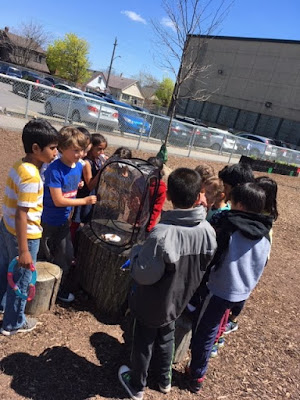
This week the children asked more questions about butterflies. By the end of the week, we went outside and release 11 butterflies and there were 6 chrysalids still in the butterfly house.

The children thought about all the changes happening inside each chrysalis. One student was wrapped in thin paper to help show and understand the difficulty of making such big changes in such a small space.

Here are some of the facts the class talked about:

* Butterflies drink but do not eat. (We put orange slices and orange Gatorade in the butterfly house for them to drink.

* A butterfly uses some of its blood to help straighten and flatten its wings when it comes out of the chrysalis. Then they push this blood out, since its not needed anymore.

* A butterfly uses its feet to taste.

* A butterfly uses its two antennae to smell.

* Their are over 100,000 kinds or species of moths and butterflies in the world. Of these, 15,000 are butterflies and 85,000 are moths.

* Butterflies breathe through holes in their sides called spiracles.

* Butterflies, like all insects, have 6 legs. However, only 4 legs can be seen. The two legs at the front are very small and short and difficult to see.

* The colours and patterns on butterfly wings are decided by the butterfly's DNA and are made up of small, coloured, overlapping scales (like pixels on a compter screen).

News for May 17


News for May 17

It was another busy week in Room 222...

From preparing and performing the poem and dance for the Spring Concert to learning about capacity and area to releasing butterflies, the students had a lot of fun learning!

In science, the butterflies have begun to emerge from their chrysalids! More information and photos
can be found in a separate posting. At the end of the week, the class watched an episode of The Magic School Bus about butterflies.

In math, the children reviewed the proper use of the mass (weight) standard units of kilogram and gram. They were introduced to the concept of capacity or the measurement of how much something can hold. The standard units for capacity are litre and millilitre. A the end of the week, the children began to talk about how to measure area, or the surface within the perimeter of a shape. Area is measured in square units.

In reading, the children did a reading response activity based on the book, "Mummy on the Nile" by Canadian author Susan Aguilo. She was an author that visited our school two weeks ago. The class were asked to answer, in writing, some questions about the story.

In social studies, the class learned the history of Victoria Day. They chorally read a short non-fiction story and then answered some questions in writing. Qeen Victoria was such a well-like queen that people began to have a holiday around her actual birthday (May 24) and the tradition is to have fireworks to celebrate. Did you know that Queen Victoria became queen when she was only 18 years old and ruled for 64 years? Queen Victoria was Queen Elizabeth's great-great grandmother.

In writing, the students worked hard to complete the good copies of their caterpillar stories and made illustrations and front covers for their books.

The class was asked to create a "gratitude chain" to use for decorations in the auditorium for the concert. Each child wrote down what they were grateful for and why on a long piece of paper and these were linked together to make a chain. One sentence was "I am grateful for my family because they love me."

Finally, the children worked very hard and practised reciting the poem and doing the dance every day to prepare for the concert on Thursday night. They even learned the history of the balloons that we used in our performance. Did you know that balloons are made of rubber and were invented by the English scientist Michael Faraday in 1824, 195 years ago? (Faraday is known for his work in electromagnetism). The class also had a chance to watch the performances of the other classes, during a full rehearsal on Wednesday afternoon.

Books read aloud this week:

Pippi Longstocking by Astrid Lindgren (chapter book - continued)
The Curious Garden by Peter Brown
Mummy on the Nile by Susan Aguuilo
The Magic School Bus - Butterflies and the Bog Beast (DVD)